
The Production Process, Application Field And Development Trend Of Phycocyanin
Leave a message
Except for blueberries, blue is not closely related to food, but in recent years, blue food has begun to appear frequently in consumers' vision. Now, you can easily use blue yogurt, blue smoothie, and blue drinks made from phycocyanin and butterfly pea flower extract powder to quickly attract attention on social media such as Xiaohongshu and Weibo, but these blue foods bring attractiveness not only visually stimulating but also because the phycocyanin and butterfly pea flower that provides the blue source is healthy raw materials that really come from nature.
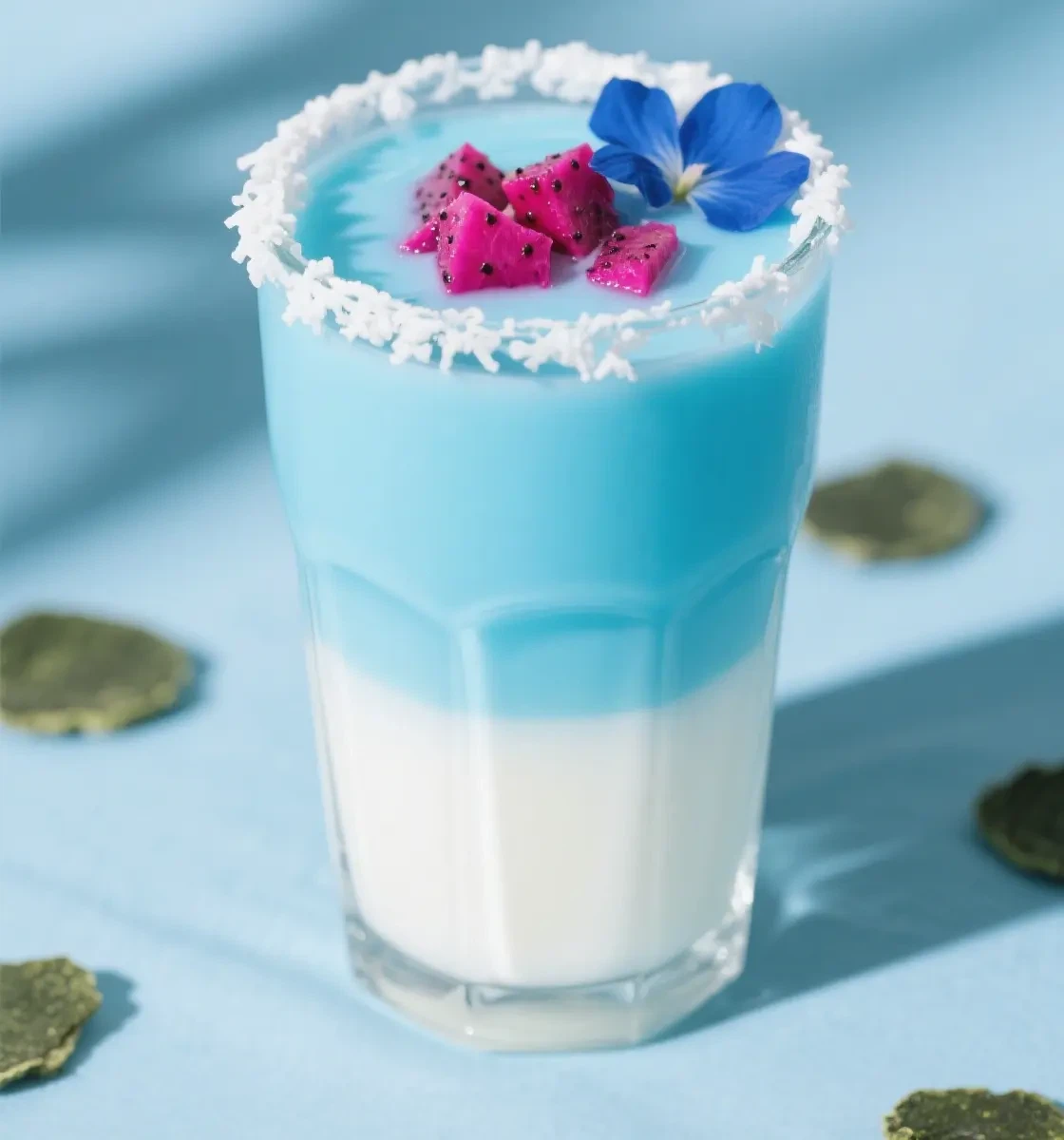
Natural Blue Pigments: Phycocyanin and Butterfly Pea
While taste is often the number one priority when it comes to food, with the rise of social media, visual innovations have become important, especially colors from natural sources (as opposed to chemically synthesized ones). Whether it can use social media fission to promote new sales growth has become a new challenge for food brands.
In Europe and the United States, phycocyanin is a well-known sky-blue pigment. Phycocyanin has not only been sought after by food giants such as Mars Nestle, but also by ordinary consumers. Phycocyanin is derived from spirulina, a microalga that grows in alkaline water lakes. The color of products after adding phycocyanin is often very close to sky blue, which makes phycocyanin a blue color for food and beverage manufacturers. first choice.
The butterfly pea flower is a rising star among blue pigments. Tea made from butterfly pea flowers is very popular in Southeast Asia. The flower of this plant is shaped like a butterfly, has a bright blue color, is sensitive to pH, and will turn purple at a certain pH value. Such as purple lemon juice.
Mintel has identified plant-derived ingredients as the top food trend for 2017, noting: "There is often conflict about what not to add to food and drink, but consumers are more interested in what goes into food and drink rather than adding nothing".
And the reason for the increase in blue foods and beverages in recent years happens to be that food manufacturers and consumers believe that these blue sources (phycocyanin and butterfly pea) are actually good for health. In other words, not everyone drinks tea to attract attention on social media, but the additional benefits of these plant-derived ingredients, such as antioxidants, will attract other consumers.
Phycocyanin is a rare blue plant protein in nature. It can be used as a natural pigment and is a protein itself. It is very in line with the current market trend of "plant protein, clean label, natural health".
Phycocyanin Production
Based on the birth of cyanobacteria, phycocyanin, as an indispensable member of cyanobacteria for photosynthesis, has appeared for about 3.5 billion years, covering most of the process of life evolution. Phycocyanin is the basis for cyanobacteria to achieve high-efficiency photosynthesis, especially in the efficient use of solar photons with a wavelength of 450-650nm. It plays the role of energy harvester on the primitive earth, so it is not too much to be called the most important substance for the origin of life.
In nature, cyanobacteria are the largest source of phycocyanin, and phycocyanin (including allophycocyanin) accounts for a large proportion of cyanobacteria cells. Taking spirulina as an example, it can account for up to 20% of the dry weight of cells. Correspondingly, It accounts for about 1/3 of the total protein of algae. If under specific culture conditions (such as low light), the content of phycocyanin can be further increased.
Except for some reagent-grade products, extracting phycocyanin from spirulina is currently the main and simplest method for commercial production of phycocyanin. Recent research has achieved the expression of phycocyanin in Escherichia coli using transgenic technology, but there is still a long way to go before similar technologies can be industrialized.
Taking the large-scale production of spirulina phycocyanin as an example, it is simply divided into the following steps in terms of technology.
(1) Breaking the wall: The first step of extraction needs to open the cell wall of the algae. Common wall-breaking techniques can be divided into two categories, physical means such as high pressure, mechanical shear, freeze-thaw, hypotonicity, ultrasound, and microwave assistance, etc., chemical methods such as mixed reagents, enzymatic hydrolysis, acid hydrolysis, active agents, etc., of course, in In production application, the difficulty of equipment and process, as well as cost controllability, must be considered first.
(2) Dissolution: Regardless of whether the raw material is dry powder or wet algae mud, it is necessary to dissolve phycocyanin into the water first. This step is usually performed together with the first step. For the stability of phycocyanin, it is necessary to control the water temperature, and Involves the setting of parameters such as ion background and pH.
(3) Separation: After solid-liquid separation and slag removal, phycocyanin dissolved in water is usually separated by salting out/protein isoelectric point flocculation to obtain crude products.
(4) Purification: The crude product needs to be further purified to remove impurity proteins and unnecessary various ions. It is applied to technical principles such as salt solution-salt-out, filtration, osmosis-reverse osmosis, chromatography, etc. There are many technological innovations in this stage of purification. A lot of new equipment has been born, and because of the different requirements for product purity, the difference in process design in the application will be very large.
(5) Preparation: Through the purification link, before the "high" purity product is supplied to the market, there is a preparation process, such as configuring a certain concentration of water or dry powder preparation, adjusting the pH, Treatments such as adding specific chemicals (such as sodium citrate) or microencapsulation.

Commercial Applications of Phycocyanin
(1) Food additives - pigments
Phycocyanin is a rare edible blue pigment in nature, and it is a gorgeous sapphire blue. The US FDA approved the application of phycocyanin in some foods in 2013/2014, including beverages, cheese, ice cream, candy, chewing gum, yogurt, pudding, and other common foods. The national standard for additive algae blue will also be implemented in March 2021 (GB 1886.309-2020), so blue foods have become more and more common in recent years.
(2) Cosmetics
The application of phycocyanin in cosmetics is mainly in the form of pigments. Common products include moisturizers, whitening creams, soap, eyeliner, lipstick, and so on.
(3) Biological efficacy
The research on the health effects of phycocyanin is the most researched content in recent years, which is enough to write a large book. The research mainly focuses on the following aspects: anti-oxidation, anti-inflammation, anti-cancer, anti-arteriosclerosis/lowering blood fat, antibacterial/antibacterial Viruses, immune regulation, neuroprotection, organ repair, reduction of drug side effects, inhibition of calculus and lipid peroxidation, wound healing, etc. Due to regulatory issues, phycocyanin products in the form of health foods or medicines have not yet been released, and most studies are still in the stage of efficacy experiments or clinical studies.
Another aspect, in particular, relates to the application of phycocyanin in photodynamic therapy. The oral explanation is: Phycocyanin, as a photosynthetic pigment, has the ability to emit electrons after being illuminated by a specific wavelength. This electron is actually destructive, interrupting or destroying some biological macromolecules (such as proteins, nucleic acids, etc.) Using this principle, phycocyanin can be injected into cancer lesions and radiated with the light of a specific wavelength, thereby destroying or killing cancer cells and achieving the effect of cancer treatment.
(4) Biochemical reagents
Phycobiliproteins, including phycocyanin, allophycocyanin, and phycoerythrin, are naturally fluorescent substances with strong excitation, wide wavelength shift, high molar extinction coefficient, and high fluorescence quantum yield. , which is superior to traditional fluorescent reagents. Phycobiliproteins prepared or modified by special means (mainly phycoerythrin and allophycocyanin) are used in some cell biologies research methods, such as fluorescence flow cytometry, fluorescence microscopy, single cell analysis, fluorescence stimulated cell sorting and Immunoassays and other techniques have been used.
The status quo and Future of the phycocyanin industry
When Mars decided to replace the chemically synthesized blue (Brilliant Blue: FD&C blue #1) in MM beans, finding a blue color that was natural, stable, and did not affect the taste became a challenge. Mars filed an application with the US FDA to request the approval of spirulina for use in chewing gum and candies, and the US FDA approved the request in 2013. In 2021, the US FDA has approved the application of butterfly pea flowers for food and beverage.
It will be an irreversible trend that nature gradually replaces chemical synthesis. In the last century, the FDA allowed 35 chemically synthesized pigments to be added to food and beverages, but up to now, there are only 7 left, and the scope of application and the amount of addition are strictly limited. We also believe that in the future, more food and beverage manufacturers will choose colors from natural sources, boldly break away from tradition, and try to use brighter and more colorful colors.
The international natural pigment market, under the trend of replacing synthetic with natural, has been showing a steady and rapid upward trend. It is estimated that the current overall market size is close to 2 billion US dollars. In the blue area, phycocyanin is the most advantageous product, and the food industry uses phycocyanin to develop many novel foods in a targeted manner, such as blue beverages, cold drinks, (plant) milk products, various Cosmetics, etc. if it can better solve the problem of product stability, there will be room for further development.
The biological efficacy of phycocyanin, that is, the effect of treatment or adjuvant treatment for various symptoms or diseases, has always been the focus of research in the field of phycocyanin, based on the results of basic research and clinical trials, although it is currently limited by regulations It is only a matter of time before phycocyanin is developed as a health food and medicine. How big is the market space in this field, I won't make predictions. After all, it's human-made. When the quality of the product has been determined, it will depend on everyone to make it down-to-earth in the later stage. How "blue" the sea is depends on how much protein you have owned.